


  RA government to present new Constitution in 2026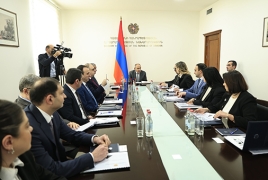 January 8, 2026 - 11:17 AMT PanARMENIAN.Net - At the Ministry of Justice, a review of the agency’s 2025 performance and plans for the upcoming year was conducted, attended by Prime Minister Nikol Pashinyan. It was announced that this year, the government plans to present a new Constitution, a Code on Administrative Offenses, and a unified digital platform for judicial administration and case management. New mechanisms will be launched for electronic criminal proceedings, e-notary services, a digital insolvency platform, and automated judicial statistics tools. Reforms will also introduce rules to enforce time limits on criminal investigations and ensure case continuity when judges are replaced. Justice Minister Srbuhi Galyan reported a performance rate of 94.7% in 2025. The ministry introduced an administrative justice platform now covering 72% of cases and modernized the Arlis system, integrating it with e-Draft for unified legal processes. A mandatory conciliation procedure for family cases and the http://e-mediation.am platform were also implemented. A proposal was made to impose strict time limits on civil and administrative case reviews: six months for civil cases (extendable twice by three months, not exceeding a year) and six months for administrative cases (with two six-month extensions, capped at 18 months). A legislative proposal was submitted to the National Assembly aiming to reduce courts’ workload by limiting appeals under 300,000 drams by administrative bodies, potentially cutting appellate court caseloads by 30% (around 2,000 cases). A new system has been introduced in the State Register of Legal Entities, integrated with the Tax Committee, Cadastre, and Central Depository. It features an improved Beneficial Ownership mechanism and automated proceedings. Since its launch in December 2025, 1,274 sole proprietors, one foundation, and four LLCs have been registered entirely online. Pashinyan stated: “Our goal in digitization should be to introduce the system, allow it to run parallel for a while, ensure it delivers, and then gradually phase out paper-based options.” Addressing repetitive citizen complaints, he added: “People send the same complaint to various ministries, Parliament, government, presidential office, and more. We must implement a one-time data principle: the state should ask for each piece of information once, and citizens should submit each request once, digitally, to reduce time and resource waste.” Officials clarified that this system is still in development. New integrity assessment regulations were presented, mandating publication of conclusions and enabling assessments of high-level officials. These were submitted to Parliament. A new concept was approved to protect personal data by creating an independent oversight body. Lawmakers were also briefed on a legislative package addressing long-standing expropriation issues in the public interest. Parliament adopted legislation launching an electronic notification system, establishing cases where such notices are mandatory and considered legally delivered. A new Insolvency Code was introduced, stipulating that proceedings can only begin based on court-acknowledged debt. It outlines consequences for debt forgiveness and mandates e-auctions to eliminate human interference. Judicial reform continued with streamlined administrative procedures, reducing court burden and accelerating cases. Written hearings were introduced in appellate, administrative, and criminal courts with a six-month deadline, extendable by four months. A bill proposes criminal liability for failing to comply with administrative acts suspending or revoking driving rights. Administrative penalties will also be tightened for driving while disqualified. The conditional early release system is under review. Pashinyan noted: “Previously, we relied on general amnesties that assessed the legal article, not the individual. Now, we must adopt a personalized evaluation system for better governance and reintegration.” From January 1, 2026, the minimum sale price of a debtor’s only home in insolvency cases will rise from 4.9 million to 7.8 million drams. In 2025, the Arbitration and Mediation Center handled over 300 arbitration and 200 mediation cases. To improve public service quality, the Ministry’s hotline was launched in September. Citizens can now get info on civil acts, property registry, administrative justice, and more. Of 16,110 calls, 8,289 were answered by AI, reducing human workload by over 49%. The Compulsory Enforcement Service recovered over 64 billion drams in 2025, which is 6.25 billion drams (11%) more than in 2024. Of this, 20.8 billion drams were transferred to the state budget, an 8% increase. Civil registry services have also gone digital. Births, marriages, paternity recognition, and other services are now available online. In the past two months, 104 marriages were registered digitally. As part of EU visa liberalization efforts, the ministry identified 26 relevant benchmarks across three main areas, with a timeline for implementation. In response to Turkish outlet Oda TV’s claim that Armenia’s new Constitution would exclude “the Armenian people,” the Ministry of Justice called the report entirely false and stated that any decision will depend on a national referendum.   Top stories Top stories Grigoryan added that the situation around the world and particularly in the region is very difficult. The Armenian Defense Ministry has denied Azerbaijan's accusations of violating the ceasefire. Armenian Prime Minister Nikol Pashinyan took to social media to thank his Lithuanian counterpart for the contribution. President of the Armenian parliament Alen Simonyan met with the Speaker of the Azerbaijani Milli Majlis Sahiba Gafarova.   Partner news |  Latest news Latest news Viva sees growing demand for cloud services Viva sees growing demand for cloud services  In recent years, medical institutions are starting to make use of Viva’s cloud servicesTurkey replacing term "Central Asia" with "Turkestan" in textbooks The Turkish Ministry of Education is replacing the term "Central Asia" with "Turkestan" in textbooks.Armenian, German presidents meet in Berlin Armenian and German Presidents Vahagn Khachaturyan and Frank-Walter Steinmeier met in Berlin.Armenia assumes presidency of Mediterranean Network of Regulatory Authorities The Commission on Television and Radio of Armenia said it expects productive cooperation in various formats. In recent years, medical institutions are starting to make use of Viva’s cloud servicesTurkey replacing term "Central Asia" with "Turkestan" in textbooks The Turkish Ministry of Education is replacing the term "Central Asia" with "Turkestan" in textbooks.Armenian, German presidents meet in Berlin Armenian and German Presidents Vahagn Khachaturyan and Frank-Walter Steinmeier met in Berlin.Armenia assumes presidency of Mediterranean Network of Regulatory Authorities The Commission on Television and Radio of Armenia said it expects productive cooperation in various formats. |