


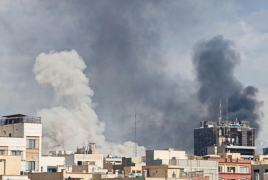


A nuclear-related facility in the Iranian city of Isfahan has been damaged following an attack carried out by the United States and Israel, the ISNA news agency reported, citing Iran’s Nuclear Safety Center.
“A gamma-radiation sterilization facility in Isfahan province was subjected to an air-launched missile attack on March 7 by the Zionist regime and the United States,” the statement said, according to RIA Novosti.
According to the agency, no reports of radioactive contamination have been received.
Earlier, Iranian authorities said that on March 1 the country’s Natanz nuclear facility — where a uranium enrichment plant is located — was struck in two phases. Officials stated that no radioactive leaks were recorded there either.
Iran has declared that it will continue developing nuclear technologies. This was stated by the head of the Atomic Energy Organization of Iran, Mohammad Eslami.
“The path of developing nuclear technologies will continue without interruption,” he said.
Iranian Foreign Minister Abbas Araghchi said Iran has received support from Russia in various areas.
“They are helping us in many different directions,” he told NBC, adding that he has no information about intelligence sharing.
U.S. President Donald Trump said Tehran bears responsibility for a strike near a girls’ school in the southern Iranian city of Minab. He made the remarks to journalists aboard Air Force One on March 8, according to Deutsche Welle.
Asked whether the United States bears responsibility for the incident, Trump replied: “No. Based on what I’ve seen, I believe Iran did it.”
At the same time, U.S. Defense Secretary Pete Hegseth, who accompanied Trump on the trip, did not directly confirm that assessment, saying the United States is currently investigating the incident.
The “Shajare Tayebe” girls’ school in Minab, located in Iran’s Hormozgan province, was destroyed in a missile strike on the morning of February 28. At least 175 people were killed, including many children, according to local authorities.
On March 5, The New York Times reported, citing satellite imagery from Planet Labs, that the school building suffered severe damage from a precision strike carried out simultaneously with attacks on a nearby naval base controlled by the Islamic Revolutionary Guard Corps.
According to the report, official U.S. statements that American forces struck naval targets near the Strait of Hormuz suggest that the United States could have been behind the strike.
Speaking to reporters aboard Air Force One, Trump also said he is not interested in negotiations with Tehran and suggested the war could end when Iran no longer has a capable army or a functioning leadership.
“I think at some point there simply won’t be anyone left to say, ‘We surrender,’” Reuters quoted him as saying.
The U.S. president also said Washington does not plan to involve Kurdish forces in military operations against Iran.
“The United States has good relations with the Kurds, but we do not want to make an already complicated war even more complicated,” Trump said.
French President Emmanuel Macron said he held a phone conversation with Iranian President Masoud Pezeshkian, urging Iran to stop strikes against countries in the Middle East and reopen the Strait of Hormuz for shipping.
“I emphasized the need for Iran to immediately stop its strikes against countries in the region. Iran must also guarantee freedom of navigation by ending the de facto closure of the Strait of Hormuz,” Macron wrote on X.
Macron also expressed concern about Iran’s nuclear program and what he called Tehran’s “destabilizing activities” in the Middle East, while stressing the importance of resolving the crisis through diplomacy.
He also raised the issue of the return to France of French citizens Cécile Kohler and Jacques Paris, who are being held in Iran. According to Macron, the two leaders agreed to maintain contact.
Trump said the exact timeline for the end of the U.S. military operation against Iran has not yet been determined, although he noted that the campaign is progressing ahead of schedule.
“I don’t know. I never make predictions. I can only say we are ahead of schedule,” Trump said.
Earlier, the White House said the military operation, code-named “Epic Fury,” could last four to five weeks. Trump also stated that U.S. ammunition reserves are nearly inexhaustible.
Meanwhile, the Islamic Revolutionary Guard Corps said it is prepared to continue military operations against the United States for up to six months.