


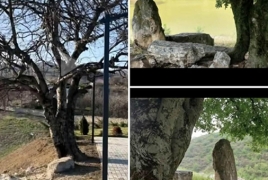


Azerbaijan is systematically destroying Artsakh’s cultural heritage, according to Hovik Avanesov, cultural heritage ombudsman of Artsakh and deputy head of the National historical-cultural NGO.
In a Facebook post, Avanesov said that on March 11, 2026, a TikTok user named xanabat muhavizə published a video from Khanabad village in the Askeran region, where a 12th-century khachkar appears to have been destroyed.
“From the video it is clearly visible that under the pretext of ‘construction works,’ the 12th-century khachkar located under a pear tree in the village was destroyed,” Avanesov wrote.
According to him, the incident is further evidence of a systematic policy aimed at erasing Armenian cultural heritage in Artsakh. He added that monuments from the same historical period are sometimes presented by Azerbaijani state propaganda as “Caucasian Albanian heritage,” while at the same time being deliberately destroyed.
Avanesov said that not only propaganda structures but also Azerbaijani armed forces and other security units are involved in the process, making the destruction of cultural monuments part of state policy.
As another example, he recalled that on February 2, 2026, the Geghard scientific-analytical foundation reported vandalism at the Holy Mother of God Church in Vaghuhas village in the Martakert region. According to the report, at least one khachkar in the churchyard was damaged, and icons were torn from the church.
Avanesov emphasized that cultural monuments in Artsakh have not only Armenian but universal significance, and that their destruction aims to erase historical and material evidence of Armenian presence in the region.
He also noted that the destruction of khachkars contradicts international law. “Armenian cross-stone art: symbolism and craftsmanship of khachkars” has been included in UNESCO’s Intangible Cultural Heritage list since 2010, and targeting such heritage may constitute a serious violation of international law and a war crime.
According to the ombudsman, the numerous documented cases indicate that what is happening can be viewed as an expression of cultural genocide, intended to erase traces of Armenian historical presence in the region.
On September 19, 2023, Azerbaijan launched a large-scale offensive against Artsakh, subjecting the territory to massive artillery shelling. One day later, on September 20, the authorities of the Nagorno-Karabakh Republic accepted a ceasefire proposal by the command of the Russian peacekeeping mission and agreed to Baku’s conditions, including the disarmament of the Defense Army and the dissolution of the republic.
As a result of the attack, 223 people were killed, including 20 civilians, six of them minors. Beginning on September 24, the forced displacement of Artsakh Armenians started, with more than 100,000 people fleeing to Armenia. According to some reports, about 20 Armenians remained in Artsakh; 11 later returned to Armenia, one died and one was detained.