


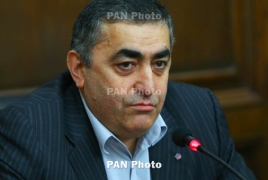


Armen Rustamyan, a member of the Armenian National Assembly’s delegation to the Parliamentary Assembly of the Council of Europe (PACE) from the Hayastan faction, addressed criticism regarding a recently adopted resolution, which some have labeled as a failure by the opposition. He stated that PACE is aware of developments in Armenia, including political prisoners and attacks on the church, but pursues its own priorities.
“If the PACE resolution on ‘Progress of the Assembly’s Monitoring Procedure’ adopted in Strasbourg represents a failure of the opposition, then by that logic, one should also consider it a failure that the West fully supports these authorities. That should come as no surprise to anyone,” Rustamyan told “Pastinfo.”
He claimed that anyone who has followed Council of Europe sessions would notice a strong anti-Russian sentiment dominating the agenda.
“In this environment, where the institution has a political stance and operates with a distinctly anti-Russian agenda, this is their main focus. Armenia’s current authorities exploit this by presenting themselves as champions of European values, while we all know what’s really happening in the country.”
Rustamyan expressed dissatisfaction with some of the resolution’s wording, particularly criticizing the cancellation of a planned monitoring co-rapporteurs’ visit to Armenia.
“We had insisted that the co-rapporteurs visit Armenia before the report was submitted, but they canceled it for vague and unacceptable reasons. They could have postponed it, as the cited reason was one co-rapporteur’s illness and hospitalization. That person has since recovered, yet the visit never happened.”
He added that they conveyed their concerns to the monitors directly. “We had to hold separate meetings with the co-rapporteurs and fully informed them of the situation in Armenia. They are well aware of everything — the existence of political prisoners, persecution and campaigns against the church. But, as I said, their political orientation is to support the current authorities at all costs. This is neither a secret nor a surprise.”
Rustamyan argued that while the resolution includes some points addressing real problems, they remain largely superficial.
“In this context, the resolution also notes a ‘certain tension’ between the Prime Minister and the church leadership, and mentions abuse of administrative resources ahead of elections. These are the other, more factual sides of the resolution.”
He believes the West’s approach is driven by political bias: “The rest stems from their overall political position, namely, the West’s unconditional support for these authorities for well-known reasons.”
He emphasized that the most troubling part is that the Council of Europe refers to reports regarding the church conflict, rather than seeing the situation firsthand.
“They simply don’t want to come and see what’s actually happening. That’s the most unacceptable part. Still, the resolution does mention the campaign against the church.”
Rustamyan concluded by saying that opposition members of Armenia’s PACE delegation will continue to raise these concerns and urged co-rapporteurs to consider not only the government’s reports but also the opposition’s perspective.
“We’ll keep pushing them to at least be objective, to listen not just to the ruling team and their narratives, but also to opposition voices. After all, they have an office in Armenia. Let them go and investigate these farcical trials. There's a lot we can tell them, because an institution that claims to defend democracy and human rights shouldn’t act this way.”
On January 26, PACE adopted a resolution titled “Progress of the Assembly’s Monitoring Procedure,” which expressed concern about tensions between Armenian Prime Minister Nikol Pashinyan and the head of the Armenian Apostolic Church.
The Armenia-related section of the resolution also raised concerns about reports of alleged plans by some clergymen to seize power. PACE further noted growing polarization ahead of parliamentary elections in Armenia and urged improved relations between the ruling majority and the opposition to avoid personal attacks during the campaign.