


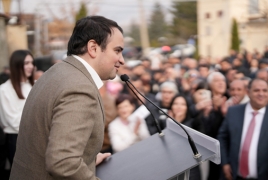


Strong Armenia will take the parliamentary seats it won in the June 7 parliamentary election, according to alliance representative Narek Karapetyan.
In a Facebook video address, Karapetyan said the alliance had decided that accepting its mandates and being represented in the National Assembly would best support future street protests.
“We concluded that the right decision is for our political force to take the mandates and be represented in the National Assembly. That will help support street protests in the future,” Karapetyan said.
He explained that the alliance had considered two possible scenarios before reaching its decision.
“The first was to enter the National Assembly and secure representation in the legislature. The second was not to enter parliament and therefore have no representation there. We then assessed the option of street protests. If 70,000 to 80,000 people take to the streets, we would have virtually no members of parliament to vote in favor of the changes we propose.
The gap in votes between the Civil Contract party and the opposition is so large that it would be practically impossible to come to power through parliament as a result of street protests. On the other hand, if we enter parliament but no street movement emerges, it would also be nearly impossible through negotiations to persuade government lawmakers that change is necessary.
That is why we reached an important conclusion: for significant change to take place in Armenia, two key elements are needed—street protests and strong opposition representation in the National Assembly. This combination will bring major change. Of course, it should happen once, in a single decisive day, and be final,” he said.
Karapetyan added that the alliance does not intend to call people into the streets unless it believes there is a genuine opportunity for major political change.
“We will call people into the streets when we see that the opportunity for change is close. By combining parliamentary work and public protests, we will achieve legitimate and peaceful change,” he said.
He also argued that the election demonstrated one clear message: the Armenian people rejected the campaign against the Church, policies aimed at weakening national identity, plans to amend the Constitution, and proposals involving concessions at the expense of national interests.
“We have blocked Aliyev’s constitutional changes. For the first time in history, Pashinyan no longer has a constitutional majority. For the first time, he has lost the confidence of the majority of the people,” Karapetyan said.
He added that Strong Armenia will also participate in municipal elections and continue working to expand public support.
Karapetyan, a member of the Strong Armenia party council, cited Georgia as an example of what he believes can happen when an opposition refuses to take its parliamentary seats.
“In 2024, Georgia’s opposition decided to boycott parliament and refuse its mandates in an attempt to create a legitimacy crisis for the government, which had received 53% of the vote.
However, the outcome was the opposite. A parliament dominated by one political force and the absence of the opposition did not weaken the ruling party but instead strengthened it further, with its approval rating reaching a record 56% in 2026,” he wrote.
The Constitutional Court rejected the appeal filed by seven political forces. Under the final election results, the parliamentary seats are allocated as follows: Civil Contract – 64 seats, Strong Armenia – 29 seats, and Hayastan Alliance – 12 seats.