


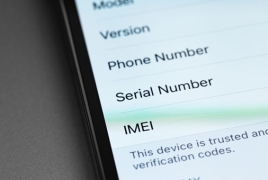


The Eurasian Economic Union (EAEU) has begun implementing a system to verify the IMEI codes of imported mobile phones.
Under a recent decision adopted by the Board of the Eurasian Economic Commission, the executive body of the EAEU, IMEI verification at this stage will apply only to Kazakhstan and Kyrgyzstan within the Union's legal framework. The requirement will cover both mobile phones imported personally by consumers and devices purchased through e-commerce, regardless of whether they are ordered directly from foreign online platforms or from warehouses located within the EAEU, Sputnik Armenia reported.
The new requirements will take effect after the corresponding amendments to the EAEU Customs Code enter into force.
"Given the growing need to register and verify mobile subscriber devices, namely phones and tablets, imported into the EAEU, we believe that the requirement to declare IMEI codes will eventually be extended to the Union's other member states," the EAEU Department for Customs Legislation and Law Enforcement Practice said.
At the EAEU level, IMEI verification has so far been formalized only for Kazakhstan and Kyrgyzstan because both countries had already introduced such systems under national legislation. In Kazakhstan, the procedure is regulated by an order of the Minister of Digital Development, Innovation and Aerospace Industry, while in Kyrgyzstan it is governed by a government resolution.
Earlier, it became known that, under a decision by the Armenian government, Armenia will also introduce a unified system for registering International Mobile Equipment Identity (IMEI) codes. Beginning on January 1, 2027, IMEI codes for mobile phones imported by individuals will be registered online, and a state fee will also be introduced.
Russia has already approved its national IMEI registration project, which will be implemented in phases from March 1, 2027, through September 1, 2028. Mobile phones whose IMEI codes are not entered into the national register will not be able to operate on Russian mobile networks.
In Kazakhstan, the IMEI codes of all devices imported into the country for the first time are subject to mandatory verification for two purposes. First, the IMEI code is checked to confirm the authenticity of the phone and determine whether it is counterfeit. It is then verified against the GSMA international database of stolen, blocked and lost devices. Only if a phone or tablet is found to be "clean" and absent from those databases is it allowed for use. Otherwise, the device is added to a blacklist, making it impossible to use SIM cards in that device within Kazakhstan.
Similar rules have already been introduced in Kyrgyzstan. The IMEI codes of imported phones and tablets must be entered into the national database.