


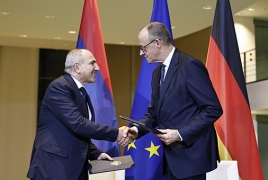


In Berlin, Armenian Prime Minister Nikol Pashinyan and German Chancellor Friedrich Merz signed a joint declaration outlining a strategic bilateral partnership agenda between Armenia and Germany.
According to the Prime Minister’s Office, the declaration confirms both sides’ intent to deepen cooperation and mutual trust, highlighting shared interests across various domains.
It reaffirms a joint commitment to promoting freedom of speech, democracy, human rights, rule of law, and a rules-based international order, including respect for sovereignty, independence, and territorial integrity, citing the UN Charter, the Helsinki Final Act, and other instruments supporting global peace and security.
The document references the Armenia-EU Comprehensive and Enhanced Partnership Agreement (CEPA) and the strategic EU-Armenia agenda, welcoming Armenia’s efforts to strengthen ties with the EU and the wider democratic community. It emphasizes joint work in political dialogue, development aid, security, cyber defense, disinformation, and economic and scientific cooperation.
Both sides praised recent developments in Armenia-Azerbaijan relations and welcomed the pre-signing of a peace agreement. They agreed that normalizing ties between Armenia and Azerbaijan, and also with Turkey, would open paths to a peaceful and prosperous South Caucasus.
The two sides reached an understanding to cooperate in the following areas (not limited to):
a. Political and diplomatic cooperation: Regular consultations among ministries, agencies, diplomatic missions, high-level visits, and thematic dialogues.
b. Economic and trade cooperation: Promotion of trade and investment, biodiversity-related collaboration (including at COP17 in Yerevan), and cooperation in energy, connectivity, infrastructure, transport, technology, and tourism.
c. Development and capacity building: Ongoing collaboration through technical and financial assistance and training in areas like sustainable development, vocational education, renewable energy, environmental protection, biodiversity, water management, good governance, judicial and constitutional reforms, and socioeconomic projects.
d. Culture, education, language, and people-to-people exchanges: Academic partnerships, research, scholarships, sister city programs, cultural initiatives, youth and sports cooperation.
e. Science, technology, and innovation: Joint research, digital transformation, emerging technologies, and innovation ecosystems.
f. Security and defense: Dialogue on regional/global security, including nuclear safety, cybersecurity, countering disinformation, defense reforms, and cooperation aligned with UN Security Council resolutions on Women, Peace, and Security.
The declaration is not a legally binding international treaty and does not establish legal obligations. Implementation depends on available resources and each party’s legal frameworks. It can be amended or terminated with mutual written consent. Either party may withdraw by notifying the other at least six months in advance.
Pashinyan is on an official visit to Germany. He has met with President Frank-Walter Steinmeier and Chancellor Friedrich Merz. On December 10, he will travel to Hamburg for further meetings.