


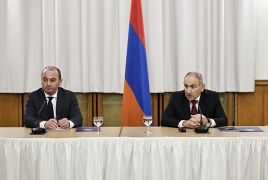


Prime Minister Nikol Pashinyan, during a press briefing in Hamburg, proposed to Azerbaijan the joint development of a roadmap aimed at simultaneously closing the topics of “Western Azerbaijan” and the return of Armenians to Nagorno-Karabakh.
“Azerbaijan speaks of ‘Western Azerbaijan’ while also referencing ‘Karabakh Armenians’. In my August 18 address, following the one on August 8, 2025, I noted that the return issue is highly dangerous,” he stated, referring to Azerbaijan’s claim that the Armenia-EU strategic agenda includes the phrase “Karabakh Armenians displaced by Azerbaijani military operations,” as reported by 1lurer.am .
“I now want to make an open and public proposal to Azerbaijan, because as long as these issues exist for them, they also exist for us. I suggest we adopt a joint roadmap to simultaneously resolve these two matters. I’ve also told our people from Karabakh that their return is unrealistic.
If we keep pushing the return agenda, it means restarting the Karabakh movement, but I’ve said we must not continue the Karabakh movement. That chapter is closed, and attempts to revive it are not helpful. Meanwhile, in Armenia, we also observe Azerbaijan repeatedly using the vague term ‘Western Azerbaijan’. Now we need to understand what the reason is and what the consequence is.
So, I am making a direct proposal now, and I hope this message gets translated and reaches its destination: let’s sit down and develop a roadmap for removing this topic, as doing so would, from a long-term strategic perspective, eliminate any potential conflict.
I’ve said before that there can be no ‘Western Azerbaijan’ in the Republic of Armenia. And yes, if we have recognized each other’s territorial integrity, and we have, then it must be implemented fully,” Pashinyan stressed.
Azerbaijan’s Foreign Ministry previously stated that the Armenia-EU strategic agenda document signed in Brussels on December 2 contradicts the peace process with Azerbaijan. It particularly objected to the term “displaced Karabakh Armenians,” asserting they “left voluntarily and refused reintegration”, and claimed that calling them refugees is a unilateral stance.