


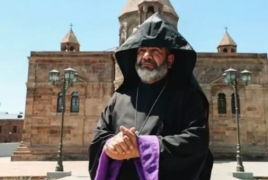


Archbishop Vazgen Mirzakhanyan, head of the Diocese of the Baltic States and one of the bishops who both shook Prime Minister Nikol Pashinyan’s hand and later accused the Catholicos of sacrilege, has stated that the only viable path forward is a direct meeting between Catholicos Karekin II and the Prime Minister to discuss terms for stepping down.
“This entire issue can only be resolved through a meeting between the Catholicos and the Prатьмime Minister to discuss the conditions for his retirement,” he said, according to RFE/RL.
Pashinyan has publicly expressed readiness to meet, but there is no indication that such a meeting is imminent. The Catholicos recently declared he would continue his mission with dedication.
“Why is retirement seen as something negative?” asked Archbishop Vazgen, citing historical examples of former Catholicoses who stepped down. He believes it’s now too late for the two leaders to meet on any matter other than resignation; a window of opportunity that existed in the summer is now closed.
The Archbishop suggested the Catholicos’s stance is being influenced by external forces, including the Armenian opposition and Russia. Although Pashinyan has made such accusations before, no evidence has been presented and no criminal cases have been filed.
When asked whether any proof had been provided, Vazgen said, “May I stay silent here... I can say yes, regarding his brother,” referring to another clergyman.
While presenting no direct evidence, he remains convinced the Catholicos serves foreign interests, using the issue of Artsakh as an example. He also challenged one-sided blame on the Armenian government, asking, “What happened under the presence of peacekeepers? Why did we lose everything? Can we just pin it all on the government?”
Despite being ordained by Catholicos Karekin II, Archbishop Vazgen now questions his leadership. He criticized actions by the National Security Service, such as allegedly pressuring clergy to omit the Catholicos's name during liturgies, and supporting defrocked clerics. However, he rejected labeling these forces as enemies.
“No one has the right to pressure clergy. But we must remember, this is our country. Our spiritual servants have been portrayed as enemies — even though our own people elected this government,” he said.
As one of ten bishops who publicly called for the Catholicos’s resignation, Vazgen had said just weeks ago that they were still cooperating with him. Asked what had changed, he explained they felt forced into this position.
“We’ve always stood by him and by Etchmiadzin. We remain canonically aligned. We’re still by his side — just not with his actions,” he clarified.
The Armenian Church currently has 56 bishops, and Vazgen believes many support the Catholicos's departure but have not yet spoken out. He hopes an episcopal council will be convened to force a resignation.
If that doesn’t happen, he asked rhetorically, “Who will work with him?” When it was suggested that the Catholicos could simply ordain new bishops loyal to him, Vazgen said it wouldn’t work: diocese leaders know their communities and hold real authority. Both the Prime Minister’s “roadmap” and the Archbishop’s view align — if the Catholicos steps down, a senior bishop will serve as interim leader.
Earlier, a group of high-ranking Armenian Apostolic Church bishops issued a statement accusing Catholicos Karekin II of covering up misconduct by Archbishop Arshak Khachatryan, Chancellor of the Mother See, despite video evidence. They claimed the Catholicos has betrayed his oath. Pashinyan met with the bishops and expressed support. In a new November 29 statement, the bishops reiterated their demand for his retirement.