


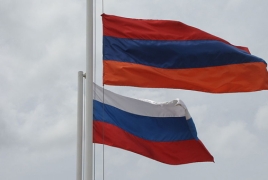


The Russian Presidential Administration is set to allocate around 13 billion rubles (approximately $165 million) to expand its soft power abroad, with Armenia as a central focus, according to sources cited by Russian outlet RBC, as reported by OC Media and Factor.am .
The initiative will be led by Sergey Kiriyenko, First Deputy Chief of Staff of the Russian President. In May 2025, Vedomosti reported that Kiriyenko had received a directive to promote Russian interests in Armenia using soft power, particularly ahead of the country’s 2026 parliamentary elections. His department has already begun activities targeting Armenia, reportedly in service of the Russian president’s broader strategic goals.
The campaign is said to be informational rather than electoral in nature. According to OC Media, the program is already in its implementation phase.
"Armenia's leadership is increasingly leaning West, which is unacceptable from the standpoint of Russian state policy," one Vedomosti source stated.
RBC's reporting details the program’s broader scope, which spans nine CIS countries and various nations in Africa and beyond. However, Armenia is set to be the primary focus in the near term, reflecting the Kremlin’s concern over Yerevan’s shifting foreign policy.
In addition to state funds, the campaign will reportedly involve agencies such as Rossotrudnichestvo, the Russian Federal Agency for International Humanitarian Cooperation, and the RT media network.
In Armenia, the initiative may include the formation or support of opposition currents aimed at Prime Minister Nikol Pashinyan ahead of the 2026 elections.
While Pashinyan has maintained ties with Moscow and visited Russia multiple times in 2025, Kremlin-aligned analysts have continued to sharply criticize him and signal a desire for both political change and a reorientation of Armenia’s foreign policy.
The report also notes a recent surge in disinformation targeting Armenia, much of which is traced to Russian, Turkish, or Azerbaijani-linked platforms.
Relations between Armenia and Russia have significantly deteriorated, particularly following Moscow's and the CSTO’s failure to respond to Azerbaijan’s territorial attacks on Armenia in 2021 and 2022. Another major point of strain was Russia’s passive role during Azerbaijan’s 2023 offensive in Nagorno-Karabakh, which led to the region’s fall after a prolonged blockade.