


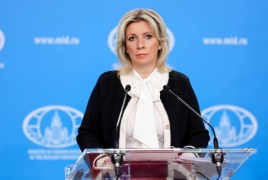


Russian Foreign Ministry spokeswoman Maria Zakharova said Armenia is free to cooperate with any partner it considers necessary, but choosing American nuclear technologies raises questions.
“The small-capacity nuclear power plants proposed by Washington do not exist even on U.S. territory. In fact, they do not exist at all; they exist only on paper,” she said, according to Sputnik Armenia.
She noted that no concrete details had been provided regarding the $9 billion small modular reactor construction project announced in Yerevan.
“This has sparked additional interest in the topic: what exactly are these reactors, and where are they already in operation?” she added.
Zakharova said several Armenian media outlets had rushed to present the news as unprecedented U.S. investment in the republic’s economy, but stressed that the key issue concerns the project’s financial model.
According to information available to the Russian side, the plan does not involve direct U.S. investment, but rather a scheme under which the Armenian side would be required to pay.
Funding was expected to be carried out through the TRIPP Foundation, which, as previously announced, is being created to implement infrastructure projects. However, the foundation itself has not yet been established.
Zakharova recalled that Russia has been a reliable partner of Armenia in the nuclear sector for decades. Throughout these years, the Russian side has supported the plant’s operation, maintenance and fuel supply.
“We are now working together to once again extend the plant’s service life until 2036,” Zakharova said.
She added that Russia is the only country in the world operating low-capacity nuclear power plants and has offered partners proven solutions on all related matters.
U.S. Vice President J.D. Vance, following a meeting with Armenian Prime Minister Nikol Pashinyan, said Armenia and the U.S. had completed negotiations on a 1-2-3 agreement in the field of civilian nuclear energy, opening broad opportunities for the implementation of major projects. He noted that this implies up to $5 billion in initial exports from the U.S., plus $4 billion in support through fuel and maintenance.