




Azerbaijan’s State Tourism Agency has developed tourism concepts for areas of Artsakh now under its control, while linking tourism promotion to its military victory narrative, according to Monument Watch.
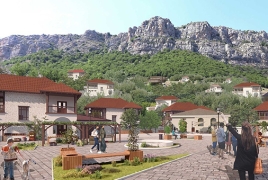
The Azerbaijani State Tourism Agency has prepared tourism development concepts for the villages of Karin Tak and Tagh, Hadrut, Mataghis and Shushi in Artsakh, which came under its control. A “Victory Road” tourist route has also been designed, starting from the Varanda region, monumentwatch.org reports, a website monitoring Artsakh’s cultural heritage.
The website draws attention to the fact that tourism is openly being integrated into the narrative of military victory.
“Since 2021, Azerbaijan has been promoting the importance of tourism in Artsakh. Evidence of this includes the first international culinary festival held in Shushi in 2022, the first scientific-practical conference on ‘Restoration and Development of Tourism in the Liberated Territories’ held in Aghdam in 2023, the international scientific conference on ‘Prospects for Cultural Tourism in the Turkic World,’ International Gastronomy Day organized in Shushi, as well as the international conference ‘Azerbaijan Health Tourism Conference: Development Opportunities.’ These events are presented as promoting the region’s tourism potential.
Azerbaijan is now also advertising Artsakh on international platforms. In reality, however, these efforts aim to create an impression of normalcy in the occupied territory for the international community: everything is legal and everything is fine.
A prominent example of Azerbaijan’s tourism approach is the project of the ‘Victory Museum’ in Stepanakert. The former building of the Nagorno-Karabakh Autonomous Oblast party committee (the presidential residence of the Republic of Artsakh) is now being transformed into a ‘Victory Museum,’” the publication states.
According to Azerbaijan’s State Tourism Agency, 35 hotels are currently operating in Artsakh. At the same time, visiting Artsakh is possible only with special permission obtained through several state platforms. The permit for travel by private car is limited to five days, and private vehicles may travel only along approved routes. Since July 23, 2025, foreign nationals have also been allowed to visit Artsakh upon obtaining the appropriate permit.
According to statistics presented on the state platform “Our Road to Karabakh,” a total of 2,549,857 people visited the region in 2025. Shushi, Lachin and Stepanakert were the leading destinations by number of visits.
“Since 2021, the Azerbaijani side has included certain occupied territories of Artsakh among Azerbaijan’s tourist destinations. Organized visits have a propagandistic nature. The narrative underlying Azerbaijan’s tourism strategy is built on a simple logic: before ‘liberation,’ the territory is presented as empty, backward or lifeless; afterward, as a developing region open to investment and hosting international events. This contrast serves one main purpose — to create the impression that real development became possible only once Armenians were no longer present in the area,” the website writes.
On September 19, 2023, Azerbaijan launched a large-scale attack against Artsakh, subjecting the territory to massive shelling. A day later, on September 20, the authorities of Artsakh accepted a ceasefire proposal by the command of the Russian peacekeeping mission, agreeing to Baku’s conditions, including the disarmament of the Defense Army and the dissolution of the Republic of Artsakh. As a result of the attack, 223 people were killed, including 20 civilians, six of them minors. From September 24, the forced displacement of Artsakh residents began, with more than 100,000 people forcibly relocated to Armenia. According to some data, around 20 Armenians remained in Artsakh, of whom 11 later returned to Armenia, one died and one was detained.