


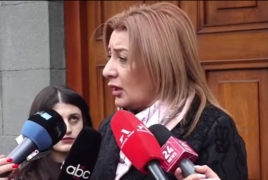


Healthcare workers gathered outside the National Assembly in protest, stating that after the launch of the universal health insurance system they received their salaries not only with delays but also at significantly lower levels. Anush Poghosyan, co-founder of the “Right to Health” NGO, said this during the rally.
“Hospital employees have received salaries about 30 percent lower, while in polyclinics they are sometimes two to three times lower. Nurses and head nurses in this structure have received much less, because doctors and nurses were usually paid on a per capita basis, and their salaries have dropped considerably,” Poghosyan noted.
According to her, salary delays have created difficulties for many employees in meeting their bank obligations.
Participants in the protest called on those responsible for the healthcare sector to sit down at one table and begin constructive discussions.
Poghosyan also said the system had been launched hastily, without proper awareness among citizens and medical workers.
“On December 31, they were asking hospitals for certain documents on the Zoom platform, and they did not even have contracts with hospitals, yet the system was starting on January 1. Insurance was introduced without the creation of a fund, and to this day, it is unclear how and with what staff that fund was established. At the time of launch, we had one employee in the Insurance Fund — the director,” she said.
In her assessment, the system was introduced while ignoring numerous shortcomings and unresolved issues, and today, the undercalculated salaries of healthcare workers are a consequence of those gaps.
One of the causes of many difficulties has also been the recurring malfunctions of the Armed electronic healthcare system. The medical community is overloaded and, under such conditions, had expected appropriate remuneration, which has not been ensured.
For those holding multiple jobs, insurance contributions have been collected twice.
“Healthcare workers’ salaries have decreased because incorrect calculations were made. People who do not interact with patients, who do not perform that titanic work and do not save lives, have decided that a healthcare worker’s salary should be that much,” urologist and andrologist Gevorg Grigoryan told reporters.
According to him, there have been cases where healthcare workers received only 19,000–50,000 drams in wages within the insurance framework.
Protest participants intend to submit letters to the Speaker of the National Assembly and to all parliamentary factions, calling for parliamentary hearings on the shortcomings and potential risks of the comprehensive mandatory health insurance system, Panorama.am reports.
“Our demand is to change the payment procedure, recalculate the minimum threshold for healthcare workers’ remuneration, and let the insurance system operate — it will indeed solve issues for our country’s residents,” Grigoryan said.
He added that the issue must be resolved by the state and not at the expense of healthcare workers.
“One segment of society should not suffer for the sake of another. We speak about social justice, but it seems social justice is not being applied to healthcare workers,” he said.
The universal health insurance system has been in force since January 1. In the first stage, it has included citizens earning 200,000 drams and more. Children under 18 and adults aged 65 and over have also been included without exception. For this group, 100 percent state support will apply in 2026.
The annual mandatory health insurance package amounts to 129,600 drams and includes preventive, early detection and screening programs, hospital services, pharmaceutical coverage and emergency care. Citizens earning between 200,000 and 500,000 drams per month will pay 300 drams monthly for this package, as a significant portion of their contribution to the “Zinapah” foundation will be allocated to the insurance system.