


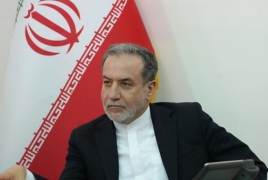


Iranian Foreign Minister Abbas Araghchi said Tehran would deliver a legitimate response in the event of a U.S. attack.
“I will not say exactly what we will do. It is obvious that we will defend ourselves. If the U.S. attacks us, we will have the full right to defend ourselves. If the U.S. attacks, it will be an act of aggression, and our response will be self-defense,” he said in an interview with CBS.
The minister acknowledged that Iranian missiles cannot reach U.S. territory, meaning that only American military bases in the region could potentially be targeted. At the same time, Araghchi stressed that he is a diplomat and supports a peaceful resolution.
Among possible steps, he proposed simplifying an agreement with the U.S. on the nuclear issue by limiting it to confirming the exclusively peaceful nature of Iran’s nuclear program and lifting certain sanctions. According to him, a preliminary version could be discussed by representatives of the two countries in Geneva next Thursday.
The foreign minister also emphasized that Tehran would not abandon uranium enrichment for peaceful purposes, calling it a sovereign right of the Islamic Republic.
Iran’s Supreme Leader Ali Khamenei has instructed the development of a set of measures in the event of his possible assassination amid a potential confrontation with the United States, media outlets reported.
According to The New York Times, citing informed sources, the relevant directives were issued as part of preparations for a possible escalation, Vesti Kavkaza wrote.
Khamenei has also ordered plans to address potential disruptions to Iran’s system of state governance in the event of a military clash with the United States.
The source said the implementation of these tasks has been entrusted to a limited circle of the Supreme Leader’s closest confidants, as well as representatives of the Islamic Revolutionary Guard Corps.
All strategically significant decisions have reportedly been delegated to former parliament speaker and secretary of the Supreme National Security Council Ali Larijani. According to The New York Times, his influence has grown significantly in recent times. Larijani is currently involved in negotiations with the U.S. over Iran’s nuclear program, oversees domestic security matters and maintains contacts with allies.
In addition, the Supreme Leader has ordered the selection of up to four potential successors in case of destabilization inside the country and in the event of his death.
Reports indicate that Khamenei has already identified three possible successors, although their names have not been disclosed. According to the source, Larijani is not among them.
Earlier, the German newspaper Bild, citing former U.S. Central Intelligence Agency employee John Kiriakou, reported that Washington could carry out a military strike against Iran on February 23 or 24. According to him, the move was supported by Secretary of State Marco Rubio and Pentagon chief Pete Hegseth, while Vice President J.D. Vance and Director of National Intelligence Tulsi Gabbard opposed it.
This week, Donald Trump said he does not rule out the possibility of a limited strike. According to The Wall Street Journal, the United States could initially target military or government facilities. If Tehran does not halt uranium enrichment afterward, Washington could launch a broader operation against state structures.
For its part, Axios reported that Washington had even considered the option of eliminating Iran’s Supreme Leader Ayatollah Ali Khamenei and his son Mojtaba.