


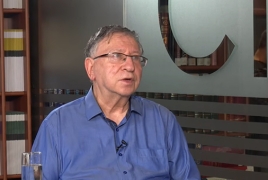


Beyond reviewing the assets of former officials, authorities must also pursue the potentially illicit property of current officeholders, said Varuzhan Hoktanyan, an expert at the Transparency International Anti-Corruption Center.
He recalled that Armenia’s anti-corruption strategy remains in force until December 31, 2026, and sets a target of reaching a Corruption Perceptions Index score of 55 this year. In 2025, Armenia scored 46 on a scale of 1 to 100, where 100 is the highest, Panorama.am reports.
According to the expert, achieving a nine-point improvement in a single year is difficult, and he has not observed signs of such progress.
Hoktanyan noted that his organization also monitors the implementation of the anti-corruption strategy, which has not been fully carried out, with some provisions not implemented at all. Recent assessments indicate that public expectations since 2018 have not been met.
He said specialized anti-corruption bodies have been established — the Anti-Corruption Committee, the Corruption Prevention Commission and anti-corruption courts — yet the situation has not changed substantially.
Responding to views that the 46 score should not be taken seriously, Hoktanyan said that all five adopted anti-corruption strategies set this indicator as a target.
“We have a culture in state institutions where everyone is to blame except themselves. If we distinguish between petty and high-level corruption, and given that the perception index is below 50, this is not small-scale corruption — it is much higher. But to label it systemic requires serious assessments.
The blatant manifestations of conflicts of interest in tenders and donations, the ‘you scratch my back, I’ll scratch yours’ principle — you make a donation to the ‘My Step’ foundation and receive customs or tax privileges in return. These phenomena are corrupt,” he said.
The expert stressed the importance of law enforcement independence, noting that failure to address issues such as tenders creates preconditions for systemic corruption.
In his view, there is currently a merger of political and economic elites, one of the main pillars of systemic corruption. He also described the bonus payment system as a form of political corruption, explaining that funds once distributed in envelopes are now formally recorded in the state budget and paid out openly.
Asked whether anti-corruption bodies could be used for political purposes, Hoktanyan responded: “Unfortunately, I have to agree. We have a problem here — there is a selective approach. It depends on who is doing it; if it is done by non-government figures, the response is quite strict.”
He also highlighted capacity gaps, particularly in the area of conflict of interest, as the register of beneficial owners does not fully reflect individuals connected to officials. Addressing the problem, he said, requires political will and comprehensive measures.
“Beyond reviewing the assets of former officials, authorities must also go after the illicitly acquired property of current ones,” the expert said.