


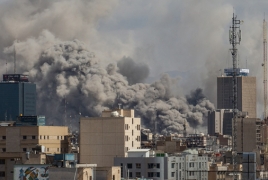


Tehran does not intend to hold any negotiations with Washington, Iran’s Supreme National Security Council Secretary Ali Larijani said, according to remarks published on his Telegram channel.
“We will not conduct any negotiations in the United States,” Larijani stated. He added that the American leader, with his “vain hopes,” had plunged the Middle East into chaos and now fears “further losses of American troops.”
U.S. President Donald Trump has pledged to continue punishing Iran “with full force” and said the war against Iran could last four weeks, according to Radio Free Europe/Radio Liberty. In a six-minute video posted on Truth Social, Trump said military operations in Iran are continuing at full intensity and will persist “until all our objectives are achieved.”
The six Arab monarchies that are members of the Gulf Cooperation Council warned Iran of possible retaliatory measures within the framework of collective security. The statement was adopted following an extraordinary online meeting at the level of foreign ministers, RIA Novosti reported.
“The Gulf countries are ready to take all necessary measures to preserve their sovereignty, security, and the stability of their states in response to Iranian attacks,” the statement said.
The foreign ministers stressed that the security of every country in the region is inseparably linked to that of others. The council also called on Iran to immediately halt its attacks in order to ensure stability in global energy markets.
Following the killing of Iran’s Supreme Leader Ayatollah Ali Khamenei, his duties will temporarily be carried out by Ayatollah Alireza Arafi, who has been included in Iran’s leadership council. The announcement was made by Mohsen Dehnavi, official representative of Iran’s Expediency Discernment Council, according to Deutsche Welle.
The 67-year-old Arafi is considered an influential Shiite cleric and was a close associate of Khamenei, who was killed a day earlier. He has been a member of the Guardian Council and the Assembly of Experts, which selects Iran’s supreme leader.
Ayatollah Ali Khamenei was killed on February 28 in Tehran as a result of a joint U.S. and Israeli air operation. After his death, authorities declared 40 days of national mourning. Khamenei had led Iran for more than three decades.
The same day, the country also lost other senior figures, including Islamic Revolutionary Guard Corps commander Mohammad Pakpour and Khamenei’s security adviser Ali Shamkhani.
Iranian state media reported that until a new supreme leader is elected, the country has been governed by a three-member interim council. In addition to Alireza Arafi, it includes President Masoud Pezeshkian and Judiciary Chief Gholam-Hossein Mohseni-Ejei.
Reza Pahlavi, son of Iran’s last shah and one of the most prominent figures of the Iranian opposition in exile, has again declared his ambition to assume leadership of the country.
In an article published March 1 in The Washington Post, he wrote: “Many Iranians, often risking their lives under gunfire, have called on me to lead this transition. I bow to their courage and have answered their call.”
According to Pahlavi, the path ahead will be transparent: adoption of a new constitution by referendum, followed by free elections under international supervision.
“When Iranians vote, the transitional government will dissolve,” he wrote.
Pahlavi stressed that Iran would not repeat the “mistakes” that occurred in Iraq after the war.
“There will be no dismantling of institutions, no power vacuum, no chaos,” he promised.
President Donald Trump said that following Khamenei’s death there are “three very good candidates” to lead Iran. He made the remark in an interview with The New York Times, without specifying whom he meant.
The White House chief also described several possible scenarios for a transfer of power in Iran that, in his view, could materialize. One option he compared to developments in Venezuela after U.S. troops detained President Nicolas Maduro and his wife and transported them to the United States. At that time, most members of the government retained their posts, declaring readiness to cooperate with Washington.
“What we did in Venezuela, I think, is an ideal, ideal scenario. Everybody kept their positions except for two people,” Trump said.
The authority to choose Khamenei’s successor lies with the Assembly of Experts, composed of 88 theologians. Iran’s Foreign Minister Abbas Araghchi did not rule out that a new leader could be elected within one or two days.
Araghchi ruled out regime change in Iran after Khamenei’s death.
“State institutions remain in place, and we have constitutional procedures in operation,” he emphasized.
CNN, citing analysts it interviewed, reported five possible candidates for the new ayatollah’s position. Among them are the late supreme leader’s second son, 56-year-old Mojtaba Khamenei; cleric and trusted associate of the former leader, 67-year-old Alireza Arafi; and Hassan Khomeini, grandson of Islamic Republic founder Ayatollah Ruhollah Khomeini, among others.
Three U.S. service members have been killed and five seriously wounded in the ongoing war with Iran, U.S. Central Command said, marking the first confirmed American fatalities since the conflict began, according to The Times of Israel.
The command also denied claims by Iran’s Islamic Revolutionary Guard Corps that ballistic missiles had struck the U.S. aircraft carrier USS Abraham Lincoln.
A U.S. defense official told Fox News that four B-2 bombers flew a round-trip mission from the United States and “dropped dozens of 2,000-pound bombs on underground ballistic missile facilities in Iran.”
The death toll from a strike on a school in southern Iran has exceeded 160, Fars news agency reported, citing local authorities.
Iranian authorities on February 28 accused the United States and Israel of carrying out a strike on a girls’ elementary school in the Minab district of Hormozgan province. “After the completion of debris removal, the bodies of 165 martyrs were recovered from the rubble of the Shadzhareh Tayebeh school,” the agency said.
Iran has launched large-scale strikes across the region, targeting not only military bases but also civilian infrastructure in the Gulf. Airports in Dubai, Abu Dhabi, Kuwait and Manama were attacked, and authorities reported one fatality in the Emirati capital following an “incident” at the airport.