


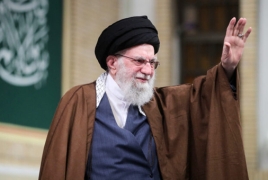


The strike that led to the death of Iran’s Supreme Leader Ayatollah Ali Khamenei was carried out not at night, as might have been assumed, but in the morning hours, after the United States and Israel decided to act on crucial intelligence received only hours earlier, BBC reports.
The report says that for several months, they had been waiting for a moment when senior Iranian officials might gather in one place, and decided that Khamenei would be present on Saturday morning at a building in central Tehran.
They were also aware of the whereabouts of other high-ranking Iranian military and intelligence officials attending the same meeting.
The U.S. and Israel had long monitored the supreme leader’s movements. The precise methods employed remain classified, but U.S. President Donald Trump hinted at them in a social media post.
“He failed to evade our intelligence and high-tech tracking systems,” Trump said.
Information about Khamenei’s location could have come from an agent on the ground, but it is considered more likely that he was identified using modern technology by tracking the movements of other Iranian officials.
During last year’s 12-day war in June, Israel carried out strikes against scientists and officials linked to Iran’s nuclear program and reportedly breached telecommunications and mobile networks to monitor individuals’ movements.
In some cases, security personnel accompanying key officials were tracked.
Over time, this made it possible to build a detailed “picture” of the leader’s daily routine and identify vulnerabilities — whom he met, how often, and where he preferred to hold meetings.
Iran was aware that the supreme leader was under close scrutiny by adversaries, so the failure to eliminate these vulnerabilities for months may indicate either a serious breakdown in security and counterintelligence systems or the adaptability of Israeli and U.S. methods in finding new ways to conduct surveillance.
The Iranian side may also have assumed that a daytime strike was less likely. In this case, as The New York Times writes, the intelligence reportedly came from an external source — the CIA — and was passed to Israel for the direct strike.
Available indications point to a division of roles: Israel focused on targets linked to Iran’s leadership, while the U.S. concentrated on military facilities.
It is important that intelligence provided sufficient advance warning about the movements of the supreme leader and other officials, enabling the planning of the attack using fighter jets capable of launching long-range missiles.
Rather than a one-off strike targeting the leadership, the plan envisioned the operation as the beginning of a broader campaign, with the timeline brought forward to seize a favorable opportunity.
Israeli fighter jets require about two hours to reach Tehran, though it remains unclear from what distance the munitions were launched.
Reports indicate that after the decision was made, Israeli aircraft fired 30 powerful bombs at the complex at around 9:40 a.m. local time. This may have been due to the fact that the supreme leader continued to use an underground bunker beneath the complex for protection, although it was reportedly not the deepest bunker available to the regime.
Multiple munitions may have been required to ensure the complete destruction of the target.
Other sites in the Iranian capital were also damaged, including the office of President Masoud Pezeshkian, which later said it was safe.
Iran confirmed the deaths of three senior officials from the defense ministry, including Defense Council Secretary Ali Shamkhani, Defense Minister Brigadier General Aziz Nasirzadeh, and Islamic Revolutionary Guard Corps commander General Mohammad Pakpour.
President Trump monitored the strike from his Mar-a-Lago residence in Florida alongside several senior officials.
Several hours passed before the death of Iran’s supreme leader was officially confirmed.
However, Tehran had prepared for such a scenario. There were reports of designated successors not only for Khamenei but also for other senior officials.
All this suggests that the impact of Khamenei’s killing on the further course of the conflict remains uncertain, the report says.
On February 28, Israel and the U.S. carried out airstrikes against Iran, killing Ayatollah Ali Khamenei. Iran responded by opening fire toward Israel and Gulf countries hosting U.S. military bases.