


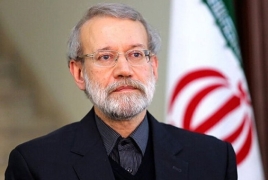


Iran has officially confirmed that Ali Larijani, head of the National Security Council and the country’s de facto leader, has been killed.
Iran’s Islamic Revolutionary Guard Corps (IRGC) also confirmed the death of Basij paramilitary commander Gholamreza Soleimani, Deutsche Welle reported.
Earlier, the Israel Defense Forces said Soleimani was killed on March 16 in a “precision strike” carried out in Tehran. Israeli Defense Minister Israel Katz also stated that the airstrike had killed Ali Larijani, though Iran did not immediately confirm the reports.
The IRGC said it would not abandon its goal of avenging the death of its commander. In a statement, the corps said Soleimani had become a “victim of a terrorist attack by the enemy.”
The Basij formation operates under the IRGC and is responsible for ideological control and internal security functions of the regime. The group is also involved in suppressing anti-government protests in Iran. The European Union has designated the IRGC as a terrorist organization.
Regarding Ali Larijani, The New York Times reported that shortly before the war with Israel and the United States began, he had assumed the functions of the Islamic Republic’s de facto leader. Iran’s Supreme Leader Ali Khamenei had tasked him at the beginning of 2026 with suppressing protests and preparing the country for war.
Larijani also maintained contacts with Tehran’s key partners — Russia, Qatar and Oman — and oversaw negotiations with the United States over Iran’s nuclear program.
Iran fired missiles with cluster warheads toward Tel Aviv in retaliation for the killing of security chief Ali Larijani, Iranian state television reported, according to Radio Azatutyun.
Two people were killed near a densely populated district of Tel Aviv where important military facilities are also located. The total number of deaths in Israel during the war has now reached at least 14.
U.S. President Donald Trump said most U.S. allies in NATO had informed Washington that they did not want to participate in a U.S. military operation against Iran. He made the remarks on March 17 while speaking to reporters in the Oval Office, calling the allies’ position “very shocking.”
“I think NATO is making a very stupid mistake. Everyone agrees with us but they don’t want to help,” Trump was quoted as saying by Reuters.
Earlier the same day, Trump wrote on the social network Truth Social that such behavior by allies did not surprise him because he had always viewed NATO as a “one-way street.”
According to him, alliance members “do nothing” for the United States, “especially when it is needed,” despite Washington spending “hundreds of billions of dollars a year” on their defense.
“With our military successes, we no longer need, nor have we ever needed, NATO’s help. The same applies to Japan, Australia or South Korea. As president of the most powerful country in the world, I say we don’t need anyone’s help,” Trump said.
Allies refuse to defend the Strait of Hormuz
Last weekend Trump called on the United Kingdom, France, China, Japan, South Korea and several other countries to support the United States in reopening the Strait of Hormuz and send their navies to the Middle East.
“If there is no response or it is negative, I think that will be very bad for NATO’s future,” he told the Financial Times on March 15.
“This is not our war; we did not start it,” German Defense Minister Boris Pistorius said on March 16.
German Chancellor Friedrich Merz expressed a similar position, noting that Germany had no mandate from the United Nations, the European Union or NATO for such a step.
European diplomacy chief Kaja Kallas said: “No one wants to get drawn into the war.”
During a meeting of EU foreign ministers in Brussels, most countries opposed expanding the mandate of the Aspides naval mission, which currently protects commercial shipping in the Red Sea.
French President Emmanuel Macron said on March 17 that France had not chosen the war against Iran launched by the United States and Israel and therefore would not participate in operations to protect the Strait of Hormuz. He said the crisis requires a diplomatic rather than military solution.
Meanwhile, Joe Kent, head of the U.S. National Counterterrorism Center, resigned, saying the war against Iran was the reason for his decision, the BBC reported.
The 45-year-old Kent, who coordinated counterterrorism efforts in Trump’s administration, urged the White House to “change course.”
Kent, a member of Trump’s team and longtime supporter, was confirmed by the U.S. Senate as head of the National Counterterrorism Center in July last year.
He became the highest-ranking official in the Trump administration to publicly criticize the U.S.–Israeli operation in Iran.
“Iran did not pose an immediate threat to our country, and it is clear that we started this war under pressure from Israel and its powerful lobby in America,” Kent wrote in a letter to Trump posted on X.
“Until June 2025 you understood that wars in the Middle East are a trap in which America has lost the precious lives of our compatriots and sacrificed the nation’s wealth and prosperity. As a veteran who participated in combat 11 times and the husband of a Gold Star recipient who lost his beloved wife Shannon in a war organized by Israel, I cannot support sending a new generation to die in a war that brings no benefit to the American people,” he wrote.
Kent is a veteran of CIA special operations forces. His wife Shannon Kent, a Navy cryptologist, was killed in Syria in 2019 in a suicide bombing.
Kent also claimed that “senior Israeli officials” and influential American journalists spread “disinformation” that undermined the Trump administration’s “America First” policy.
Trump commented on Kent’s resignation during a meeting with Irish Prime Minister Micheál Martin.
“I read his statement,” the U.S. president said. “I always thought he was a good man, but I always believed he was weak on security — very weak on security.”
“When I read his statement, I realized it was good that he left because he said Iran was not a threat. Iran was a threat — all countries understood what kind of threat Iran was,” Trump said.
White House press secretary Karoline Leavitt said Kent’s letter contained “many claims that do not correspond to reality.”
On February 28, Israel and the United States carried out airstrikes on Iran. During the strikes, Iran’s Supreme Leader Ayatollah Ali Khamenei was killed. Iran then launched retaliatory attacks against Israel and Gulf states hosting U.S. military bases.