


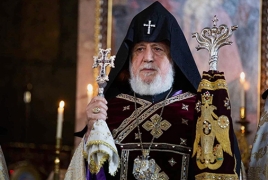


A decision banning Catholicos of All Armenians Karekin II from traveling to Georgia has drawn negative reactions not only in Armenia but also on international platforms, lawyer Ara Zohrabyan said.
According to him, the investigator’s decision to prevent Karekin II from attending the funeral of Georgia’s Catholicos constitutes a serious problem and a disgrace, Sputnik Armenia reports.
“This has had a very negative impact; the issue is already being discussed in various countries, and naturally, this was a disgrace for our country. However, we also saw that the day before, Nikol Pashinyan made negative remarks about the Supreme Patriarch. From that message, it was already clear the investigator would act in this way. Honestly, I had hoped they would at least proceed with a presumption of reasonableness, but unfortunately that did not happen,” Zohrabyan said.
In his assessment, recent changes in preventive measures applied to clergy do not indicate fundamental reforms in the judicial system. The overall approach has not changed, though in certain cases, outcomes depended on the independence of specific judges. He noted that decisions in the cases of Archbishops Mkrtich and Mikael were revised after appellate intervention, when violations were identified.
“The authorities have not abandoned the anti-church campaign; they are simply changing methods, because they realized their previous approaches—for example, editing the content of the Holy Liturgy—did not work, and believers did not follow them, understanding it was wrong. The same negative attitude exists within the judiciary. Of course, some judges handling our clergy’s cases understand this and do not want to act as they are, but unfortunately they are operating under today’s political climate,” he said.
The lawyer reaffirmed his earlier claim that judges who have issued unlawful decisions must be held accountable. However, he added that this process is complicated by the position of the Supreme Judicial Council, which he says supports the authorities.
“We are taking steps in that direction, and over time you will see that those who acted unlawfully will be held accountable,” the lawyer stated.
Zohrabyan did not rule out the use of international legal mechanisms if the issues are not resolved domestically. According to him, such tools exist and will be applied if necessary, although priority is still given to internal processes.
He also addressed ongoing legal proceedings related to church property and individual monasteries, noting that cases have already been initiated in multiple directions.
“There are civil cases demanding eviction, as well as administrative cases aimed at challenging police actions. In addition, in some instances, criminal cases have been launched on the grounds of unlawful use of church property,” Zohrabyan added.
Summing up, the lawyer emphasized what he described as an unequal approach by law enforcement bodies: they do not serve the church’s interests but react quickly when any interests against the church arise.