


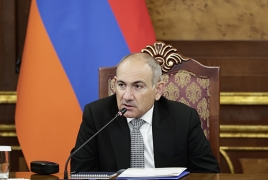


A group of non-governmental organizations stated they consider unacceptable and condemn the behavior and language used by Prime Minister Nikol Pashinyan during a March 22 conversation with a woman forcibly displaced from Nagorno-Karabakh, calling it a violation of public conduct standards and an expression of intolerance and hate speech toward displaced Armenians.
According to the statement, on March 22, 2026, during a campaign event in the Yerevan metro, Pashinyan approached a woman traveling with her child and offered them a pin depicting the map of Armenia. The woman refused, noting they were from Nagorno-Karabakh and had a different map. During the exchange, Pashinyan raised his voice and spoke while gesturing with his finger. After the woman asked him not to raise his voice or gesture that way, he responded that he would continue speaking in that manner and reproached her, stating that millions had been spent from Armenia’s budget to support Armenians in Nagorno-Karabakh and saying, “next time, don’t try to say that I gave away Karabakh.” The video also shows the woman asking to stop the conversation and not to film her and her child, but both the exchange and recording continued.
Other representatives of the ruling party and members of the prime minister’s security detail were present during the incident. The statement notes that the prime minister always acts in his official capacity, which may be perceived as embodying public authority, and such behavior may be regarded as psychological pressure toward the woman.
Particular concern was expressed that the exchange took place in the presence of the woman’s child. The child not only witnessed such behavior toward their mother but was also directly involved in campaign activity, which the NGOs consider unacceptable as it shapes perceptions of power, communication, and relationships.
The statement also says the incident sends a signal to society that legitimizes violence and polarization, which may intensify ahead of elections.
Although the prime minister later apologized, the NGOs say his remarks have already triggered another wave of hate speech targeting people from Nagorno-Karabakh, especially on social media.
They also noted that the spread of such rhetoric was amplified by an article published by civic.am, a media outlet affiliated with the Civil Contract party, which they claim aimed to discredit the woman.
The statement adds that similar expressions of hate speech, targeting, and offensive rhetoric toward forcibly displaced Armenians are not isolated cases among public officials, including Prime Minister Pashinyan and National Assembly Speaker Alen Simonyan. Given that the conduct of public officials influences broader social behavior, such actions are seen as especially concerning, contributing to polarization and the marginalization of displaced populations.
The NGOs stressed that intolerance and hate speech toward displaced Armenians—particularly on social media—remain a serious issue, with insufficient countermeasures and, in some cases, encouragement from public officials.
Considering the vulnerability of displaced persons, the statement urges public officials, especially senior leaders, to exercise restraint and respect in communication, ensuring the protection of human dignity. It also notes that public speech containing hatred, discrimination, intolerance, or hostility may constitute elements of a criminal offense depending on intent.
The statement further emphasizes that the Armenian population of Nagorno-Karabakh was subjected to ethnic cleansing and forced displacement by Azerbaijan as part of a state policy aimed at removing the ethnic Armenian presence from the region.
It states that this policy was accompanied by prolonged and severe violations of rights and freedoms, as well as serious war crimes. The continued policy of intimidation, the long-term blockade, and the military attack of September 19, 2023, are described as its culmination, making it impossible for the population to live safely and with dignity, ultimately leading to mass displacement.
The statement concludes with demands to Armenian authorities, particularly Prime Minister Pashinyan, including:
- Refrain from and prevent the use of hate speech, intolerance, discrimination, and offensive rhetoric, including on social media and affiliated media outlets;
- Hold accountable those who express and spread hate speech toward displaced populations;
- Maintain restraint and adhere to ethical standards expected of public officials;
- Ensure moderation of hate speech content on social media platforms by public officials and media;
- Guarantee respect for human rights and uphold the rule of law, including protection of privacy.
The statement was signed by 16 NGOs, including Protection of Rights Without Borders, New Culture of Justice, Armenian Progressive Youth, the Public Journalism Club, and the Yerevan Press Club.