


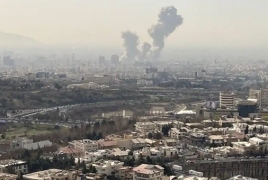


U.S. President Donald Trump has accepted Iran’s proposal and suspended strikes for two weeks, while Tehran has agreed to reopen the Strait of Hormuz, BBC reports.
“I agree to halt attacks and bombings against Iran for two weeks,” Trump wrote on social media.
Trump said he had received a “10-point proposal” from Iran, which he considers a “working basis for negotiations.” According to him, the two-week period is needed to finalize the agreement text.
Iran, in turn, confirmed its readiness for a ceasefire while also putting forward several conditions of its own.
Israel expressed support for the ceasefire, emphasizing that it does not apply to Lebanon.
Trump had earlier warned that if Iran did not unblock the Strait of Hormuz—through which about 20% of global oil and liquefied natural gas passes in peacetime—the United States would strike civilian infrastructure, including bridges and power plants, and even “eliminate Iranian civilization.” The ultimatum was set to expire on April 8 at 01:00 GMT (04:00 Yerevan time). When Trump announced the ceasefire, just over an hour remained before the deadline.
In recent hours, Pakistan, acting as a mediator between Iran and the United States, publicly stated that it had conveyed a peace proposal under which Washington would halt bombing for two weeks and Tehran would reopen the strait. In his statement, Trump noted he had spoken with Pakistani Prime Minister Shehbaz Sharif and Field Marshal Asim Munir, who urged him to “restrain the destructive force heading toward Iran tonight.”
“Almost all previously disputed issues between the United States and Iran have been agreed upon, but the two-week period will allow finalization and implementation of the agreement,” the president wrote.
About an hour after Trump’s statement, Iran’s Foreign Minister Abbas Araghchi and the country’s Supreme National Security Council confirmed that Tehran agreed to the two-week ceasefire and the restoration of navigation through the Strait of Hormuz. Araghchi stressed that navigation became possible “in coordination with Iran’s armed forces and with proper consideration of technical limitations.”
Iranian state television quickly broadcast Trump’s statement, presenting the situation as follows: “Trump announced a two-week ceasefire, accepting Iran’s conditions to end the war.” It also described his statement as a “humiliating retreat from anti-Iranian rhetoric.”
Pakistan’s Prime Minister Shehbaz Sharif said the ceasefire took effect “immediately,” noting that the sides finalized it just 10 minutes before the ultimatum expired.
Even after the ceasefire announcement, air raid alerts continued in Israel and Gulf Arab countries due to Iranian missile and drone launches.
Global financial markets reacted to reports of the two-week ceasefire with a drop in oil and petroleum product prices. On the morning of April 8, Brent crude futures hovered around $95 per barrel, compared to about $110 the previous day, according to price-tracking data cited by Deutsche Welle.
According to Trading Economics, crude oil fell by 14% in one day on global markets, reaching $96 per barrel. Heating oil widely used in the U.S. dropped by 17% in the same period, while gasoline declined by nearly 10%.
The decline in oil sector prices became a clear market response to the ceasefire reports in the conflict involving the United States, Israel, and Iran, as well as expectations of a possible imminent lifting of the blockade of the Strait of Hormuz.
The United States and Israel have carried out airstrikes on Iranian territory since February 28. These attacks reportedly killed Supreme Leader Ayatollah Ali Khamenei, along with several high-ranking officials and security representatives. He was succeeded by his 56-year-old son Mojtaba, who has not appeared publicly or issued any video messages since the start of the conflict.
In response, Iran launched missile and drone strikes on Israel and U.S. military bases in Gulf countries. Tehran also struck oil storage facilities in several countries in the region and oil tankers passing through the Strait of Hormuz. The blockade of the strait became a serious challenge for Trump, who failed to resolve the situation either through threats or by involving NATO countries.