


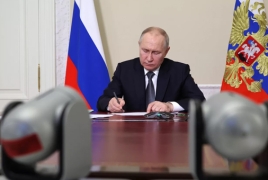


Russian President Vladimir Putin has signed a law introducing criminal liability for denying or justifying the “genocide of the Soviet people” committed by the Nazis during the Great Patriotic War, as well as for insulting the memory of its victims. The document was published on April 9 on the official legal information portal.
Amendments were made to Article 354.1 of the Russian Criminal Code, which concerns the “rehabilitation of Nazism.” Denial or justification of the “genocide of the Soviet people,” as well as insulting the memory of victims of this crime, is punishable by a fine of up to 3 million rubles, compulsory labor, or imprisonment for up to three years, Deutsche Welle reported.
Additionally, Article 243.4 of the Criminal Code has been supplemented with the wording “desecration of military burials.” The destruction, damage, or desecration of graves of victims of the “genocide of the Soviet people,” whether located within Russia or abroad, as well as the desecration of monuments, memorials, obelisks, and other commemorative structures dedicated to their memory, is punishable by fines ranging from 2 to 5 million rubles, compulsory labor for up to five years, or imprisonment for the same term.
The concept of the “genocide of the Soviet people” has been codified in Russia by a law of the same name, which came into force on January 1, 2026. According to that law, genocide is defined as “the actions of the Nazis and their collaborators during the Great Patriotic War of 1941–1945 aimed at the total or partial destruction of national, ethnic, and racial groups living on the territory of the USSR.”
Russia also imposes penalties for equating USSR with Nazi Germany
In April 2022, Putin signed a law introducing administrative liability for publicly equating the goals and actions of the USSR and Nazi Germany, as well as for denying the USSR’s “decisive role” and “humanitarian mission” in World War II.
Violators face fines of 1,000–2,000 rubles or up to 15 days of administrative detention. For officials, fines range from 2,000 to 4,000 rubles, and for legal entities from 10,000 to 50,000 rubles. In case of repeated violations, fines increase to 5,000 rubles for individuals, up to 20,000 for officials, and up to 100,000 rubles for legal entities. Additionally, officials may face disqualification for six months to one year, while legal entities may face administrative suspension of activities for up to 90 days.
On March 31, the Russian State Duma adopted the law in its second and third readings.