


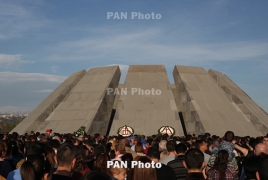


On April 24, Armenians in Armenia and worldwide commemorate the 1.5 million innocent victims of the Armenian Genocide in the Ottoman Empire.
From early morning, thousands of people visit the Tsitsernakaberd hill to observe the 111th anniversary of the crime.
On April 24, 1915, about 250 people were arrested in Istanbul, and more than 800 people across the empire, after an order was issued to deport the entire Armenian intelligentsia. The detainees were put on a train at Haydarpasha station, and no one ever saw them again. Armenian intellectuals had their heads smashed with stones, were tortured and shot. But mass killings of Armenians had begun earlier, in 1894-1896, under Sultan Abdul Hamid. According to various estimates, 1.5-2 million Armenians were exterminated in the Ottoman Empire during World War I. The population of the six vilayets of Western Armenia was completely massacred.
The Armenian Diaspora formed as a consequence of the Genocide: Armenians who barely escaped the genocide and found refuge in other countries, and their descendants. As early as the years when the Genocide was being carried out, in 1915-1923, powers adopted resolutions condemning the massacres of Armenians. The U.S. adopted such resolutions three times, in 1916, 1919 and 1920, but that did not stop the actions of the Ottoman Empire. In 1915, France, Great Britain and Russia issued a joint declaration condemning the extermination of Armenians. More than a century has passed, yet Turkey denies the fact of the Armenian Genocide and pursues a fierce policy of rejection of that historical reality in both its foreign and domestic policy.
Uruguay was the first to recognize the Armenian Genocide as a historical fact, in 1965. A number of countries followed its example, including France, Italy, Germany, the Netherlands, Belgium, Poland, Lithuania, Slovakia, Sweden, Switzerland, Greece, Cyprus, Lebanon, Canada, Venezuela, Argentina, Brazil, Chile, the Vatican, Bolivia, the Czech Republic, Austria, Luxembourg and the U.S., as well as the Vatican, the European Parliament and the World Council of Churches.