


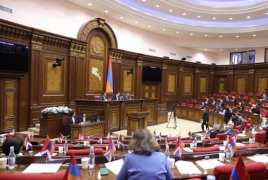


At an extraordinary session, Armenia’s National Assembly adopted in the second and final reading the package of amendments to the law “On Identity Documents” and related legislation, presented by Interior Minister Arpine Sargsyan.
She said the draft pursues several goals: a new biometric system is being introduced in Armenia, and the regulations are intended to ensure proper legal procedures, Radar Armenia reports.
“In a broader context, this is another step toward bringing the Republic of Armenia closer to visa liberalization with the European Union,” Minister Sargsyan emphasized.
The interior minister stated that Armenia had received the first progress report on the Visa Liberalization Action Plan from the European Union, which specifically highlighted the importance of the law “On Identity Documents.” According to her, the legislation should systematically organize all procedures necessary for introducing the biometric system.
Under the proposed package, possession of an identification card will become mandatory for citizens aged 16 and older. For children between 6 and 16, obtaining an ID card will remain voluntary, while for children under six, a birth certificate will continue to serve as an identity document.
“Currently, the card is issued only to individuals who have reached the age of 16. I believe this flexible government policy will allow us to establish a far more institutional and structured solution in the field of public services and identity documents in general,” Arpine Sargsyan said.
The minister noted that all travel documents issued under the new law will comply with the International Civil Aviation Organization’s ICAO 9303 standards.
Arpine Sargsyan also stressed that all documents intended for foreigners must contain biometric data. She clarified that although legislation had previously allowed such a possibility, no operational steps had been taken in that direction.
Another major change, according to the minister, is that for the first time a large-scale solution at the national level has been developed through a public-private partnership model, meaning legislation must also define proper procedures and distribution of responsibilities.
“I want to once again emphasize that the state retains its full decision-making authority. The private sector cannot undertake any action, inaction, or other step that would create factual consequences for our citizens,” the minister said.
Summing up, the interior minister stated that the law and the biometric system would also support the Armenian government’s digitalization policy.
“Very often we consider different solutions, but they are sometimes delayed or cannot be implemented quickly and fully because Armenia does not have a biometric system and relies on a system that has seen no investment for years. I believe that by the autumn of 2026 we will witness a completely new situation in Armenia, and the pace of digitalization will accelerate even further,” Arpine Sargsyan said during the parliamentary session.
The minister also answered lawmakers’ questions.
Beginning in autumn 2026, Armenia will introduce new red biometric passports. They will comply with high international standards while also reflecting Armenian identity. The design will feature the outline map of Armenia, the alphabet created by Mesrop Mashtots, and the first Armenian sentence: “To know wisdom and instruction, to perceive the words of understanding.”
The current blue passports will remain valid until their expiration dates.