


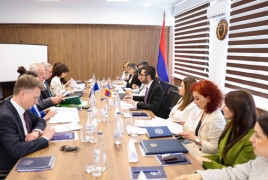


Johannes Luchner, deputy director-general for migration and home affairs at the European Commission, and Armenian Deputy Interior Minister Armen Ghazaryan, together with representatives of state institutions, discussed the European Commission’s first progress report on Armenia’s implementation of the Armenia-EU Visa Liberalization Action Plan (VLAP), as well as the recommendations included in the document.
During the discussions, the sides thoroughly reviewed progress on benchmarks set under the four main pillars of the action plan, particularly reforms related to document security, integrated border management, public order and the protection of fundamental human rights.
The Armenian side presented institutional and operational reforms aimed at managing migration risks and integrated border control, preventing illegal migration and effectively implementing readmission agreements.
Within the framework of introducing biometric passports and identification cards, Armenian officials presented the implementation stages of the program, data management mechanisms and clarified the project deadlines.
Speaking about the modernization of the educational system, Armen Ghazaryan said that, alongside police and rescue personnel training programs at the Interior Ministry educational complex, Armenia also plans to introduce specialized educational programs for border guards based on international best practices and modern methodologies. According to him, developing professional capacities is an important prerequisite for effective border management.
The sides also discussed implementation of benchmarks related to public order and security. Armenian officials presented measures aimed at preventing and combating organized crime, including the development of a crime prevention strategy and action plan, the introduction of an intelligence-led policing model and the advancement of a national threat assessment system for serious and organized crime.
The discussions also covered operational information exchange through the SIENA system in cooperation with Europol, the formation of interagency operational groups, the establishment of an asset recovery office, the strengthening of cybercrime-fighting capacities and the creation of a cyber laboratory.
The implementation of the 2025-2027 strategy and action plan against the non-medical use and illegal trafficking of narcotic drugs and psychotropic substances was also discussed.
The European side requested clarification on timelines and expected outcomes for several planned measures.
European representatives highly praised the progress achieved and stressed the importance of Armenia’s commitment to ensuring the continuity of reforms. Armen Ghazaryan reaffirmed the Interior Ministry’s readiness to continue effective implementation of the visa liberalization action plan in close cooperation with European partners.
Following the sixth Armenia-EU Partnership Council meeting held in Brussels on December 2, 2025, Armenia and the European Union signed a strategic partnership agenda. The document was signed by Armenian Foreign Minister Ararat Mirzoyan and EU High Representative for Foreign Affairs and Security Policy Kaja Kallas.