


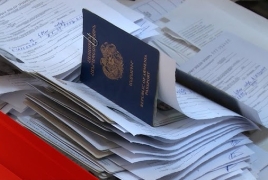


Armenia’s Ministry of Internal Affairs (MIA) will submit draft legislation in the coming months aimed at tightening the procedure for foreign nationals seeking Armenian citizenship. The announcement was made by Deputy Interior Minister Armen Ghazaryan during discussions in the National Assembly on the implementation of the 2025 state budget.
According to Ghazaryan, the ministry does not consider the current requirements sufficiently strict. Under existing regulations, foreign nationals may obtain Armenian citizenship after meeting the legally prescribed period of permanent residence in the country, Sputnik Armenia reported.
At the same time, Ghazaryan noted that differing views exist on the issue. Representatives of the business community, as well as the Ministry of High-Tech Industry, support simplifying residence conditions for foreign citizens in Armenia in order to attract highly qualified specialists.
Nevertheless, the Ministry of Internal Affairs maintains that making citizenship too easily accessible could reduce the value of the institution of citizenship and diminish public respect for it.
Under current legislation, foreign nationals of non-Armenian origin may apply for Armenian citizenship if they have continuously resided in Armenia for the previous three years. The same right is granted to individuals who have been married to an Armenian citizen for at least two years and have permanently resided in the country for at least one year.
At present, Armenia does not provide a separate residence permit regime for foreign specialists employed in the high-tech sector. Like employees in other fields, they must present an employment contract with an Armenian employer in order to obtain residency status.
At the same time, citizens of Russia and other member states of the Eurasian Economic Union benefit from a simplified framework governing employment and residence in Armenia.
Armenia does not officially operate a citizenship-by-investment program.
In 2025, Armenian citizenship was granted to 25,670 foreign nationals, primarily from Russia, as well as from Georgia and Iran.