


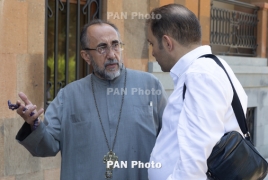


Roman Aharonyan, defense attorney for Shirak Diocese Primate Archbishop Mikael Ajapahyan, told the Criminal Court of Appeal that the investigation in the case was not objective.
“We have not been dealing with an objective investigation,” he said, according to Panorama.am .
According to Aharonyan, the indictment does not describe the manner in which the alleged calls were made, and at most it can be assumed that the accused was aware of being filmed because a camera had been installed.
The lawyer argued that the court of first instance referred to factual circumstances that were neither contained in the case materials nor discussed during proceedings. He said that part of the court’s conclusions was based on those circumstances.
In Aharonyan’s assessment, a court may draw conclusions only from facts that have been properly established through legal procedures.
“The court states in several places that the purpose of the alleged call was the seizure of power, and then it states that it was intended to incite society to unlawful actions,” Aharonyan said.
According to the defense lawyer, all of the facts cited in the case are general in nature and lack sufficient specificity.
Ajapahyan was convicted under charges related to public calls against the constitutional order and is currently challenging that ruling.
He was arrested for two months on June 28, 2025, and his detention was later extended. Public criminal prosecution was initiated against him under Part 2 of Article 422 of Armenia’s Criminal Code, which concerns public calls aimed at seizing power, violating territorial integrity, renouncing sovereignty, or violently overthrowing the constitutional order.
The court found Ajapahyan guilty under the charge and, in a decision issued on October 3, 2025, sentenced him to two years in prison. Later, on February 6, 2026, the court revoked his detention and placed him under house arrest.