


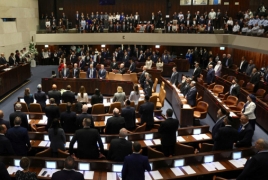


Israel's parliament, the Knesset, has postponed the vote on a resolution recognizing the Armenian Genocide. An Israeli official confirmed the decision, JNS reported.
The decision was made amid renewed regional tensions after ongoing Iranian attacks in the Persian Gulf disrupted the ceasefire. It also followed last week's NATO summit in Turkey, where Ankara urged U.S. President Donald Trump to resume deliveries of American F-35 fighter jets to Turkey.
In June, Israel's government unanimously approved a proposal to classify the atrocities committed against Armenians in the Ottoman Empire as genocide. The move came against the backdrop of a sharp deterioration in relations with Turkey following harsh statements by President Recep Tayyip Erdogan directed at Israel. The Knesset had been expected to give the initiative final approval.
The Israeli official told JNS that the vote has now been frozen. The Knesset is set to begin its summer recess at the end of the week and will not reconvene until the nationwide elections scheduled for October 27.
A spokesperson for Israeli Foreign Minister Gideon Sa'ar, whose initiative was submitted to the government last month, did not respond to calls or messages requesting comment.
The report notes that Israel had previously avoided officially describing the mass atrocities committed more than a century ago as genocide. However, after relations with Turkey sharply deteriorated, the government approved the move.
Israeli Prime Minister Benjamin Netanyahu has previously described the atrocities committed against Armenians as genocide, but no official parliamentary vote on the issue had ever been held until now.
Turkey, one of Israel's strongest international critics over the Gaza war, described the government's decision as "politically motivated."
The suspension of the parliamentary vote may be viewed as part of broader international efforts to reduce tensions between the two countries amid continuing regional instability.
Last month, Azerbaijan condemned the Israeli government's decision and called for it to be revoked.
"The secular Shiite Muslim nation of Azerbaijan has longstanding ties with both Turkey and Israel and has for many years sought to serve as a mediator between its two allies.
Azerbaijan's position carries both strategic and sensitive significance for Israel, as Jerusalem and Baku have built a strong partnership over the years based on historical ties, deepened through security and energy cooperation.
Three years ago, Azerbaijan made history by becoming the first Shiite Muslim country to open an embassy in Israel, disregarding threats of violence from Iran, and since then has continued to maintain its strong alliance with Israel throughout regional conflicts," the article states.
On June 28, Israel's government unanimously approved an initiative presented by Foreign Minister Gideon Sa'ar, officially recognizing the Armenian Genocide. Earlier, Israeli Prime Minister Benjamin Netanyahu said he supported the initiative to recognize the Armenian Genocide.
"It is never too late to do the right thing. This terrible genocide, which occurred more than 100 years ago and whose historical facts are truly indisputable, involved the killing of one and a half million people and the destruction of an ancient cultural and historical heritage," Sa'ar said.
The Armenian government does not intend to issue an official response to Israel's decision to recognize the Armenian Genocide. Prime Minister Nikol Pashinyan made the statement after a meeting of the Civil Contract party's governing board.