

  Armenia prepares first EU fish shipments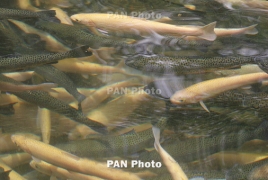 July 17, 2026 - 18:26 AMT PanARMENIAN.Net - About 97% of Armenia's aquaculture sector is ready to export to the European Union, Tigran Petrosyan, head of Armenia's Food Safety Inspection Body, said. According to Sputnik Armenia, one company has already officially submitted a written application to the inspection authority to begin exporting fish and fish products from Armenia to EU member states. The Armenian government has approved the procedures governing fish and fish product exports to the European Union. Under the new rules, businesses must successfully complete inspections by the Food Safety Inspection Body and register in the EU's TRACES control system. Petrosyan said five companies had applied to Armenia's Ministry of Economy with plans to export to the EU, but so far only one has formally submitted the required electronic application to the inspection authority. He announced that four experts from EU member states are scheduled to arrive in Armenia on July 20 to oversee compliance with export procedures during the preparation of the first shipment and to provide the necessary technical guidance. Petrosyan explained that companies must first register in the TRACES system before exporting to Europe. To do so, they must submit a package of documents covering 18 requirements to the Food Safety Inspection Body, which will review the application within five working days. It will then be forwarded to the relevant European authorities for approval. Once approved, the exporter will receive a unique identification code with no expiration date. He stressed that registration does not end regulatory oversight. The inspection authority will carry out at least one inspection annually, while businesses found in violation will first be given an opportunity to correct deficiencies before any further measures are considered. At this stage, only non-live fish products may be exported to the European Union, including chilled, frozen, salted, smoked and canned fish. Petrosyan said it is still too early to assess demand for Armenian fish products in the European market, although the Armenian diaspora could help support initial sales. Speaking about exports of whitefish (sig), he noted that shipments would be introduced gradually because domestic restrictions on the species remain in force. Addressing export issues with Russia, Petrosyan emphasized that the measures imposed are temporary restrictions rather than sanctions. "The issues are being resolved, and laboratory tests have already shown that the diseases previously detected at the inspected fish farms are no longer present. I want to stress that these are not sanctions but temporary restrictions. Where there is a problem, there is also a solution," he said. Petrosyan also noted, according to Panorama.am , that exporting products to the European Union requires at least five years of monitoring. "The European Union requires five years or more of monitoring before allowing product imports," he said. He explained that during that five-year period, the inspection authority carried out a government-approved monitoring program. Samples were collected each year from fish farms across different regions of Armenia, as well as from honey producers, and underwent laboratory testing. Annual monitoring reports were then submitted to the European Union. After reviewing five consecutive years of results and confirming compliance with EU requirements, including standards related to residues and antibiotics, the European side decided last year to allow imports of fish and fish products from Armenia. Petrosyan also revealed that 50 trucks loaded with apricots are currently preparing to export their cargo to a new foreign market. Russia remains the largest export market for Armenian fish and fish products. Against that backdrop, the first shipments to the European Union are being viewed as an effort to open a new market rather than replace exports to Russia. On May 15, Russia's Federal Service for Veterinary and Phytosanitary Surveillance (Rosselkhoznadzor) announced plans to inspect several Armenian companies whose exports to Russia had previously been suspended. The agency cited suspicions involving allegedly falsified imports of fish products claimed to be of European origin.   Top stories Top stories Yerevan has dismissed Turkey’s demand to shut down the Armenian nuclear power plant as “inappropriate”. Armenia will loan 2.9 billion drams to Nagorno Karabakh (Artsakh), according to a draft government decision. The Ministry of Ecology and Natural Resources of Azerbaijan has “strongly condemned” Armenia’s decision. Kerobyan has said that for the first time in the history of Armenia, the volume of foreign direct investments amounted to about $1 billion.   Partner news |  Latest news Latest news Viva sees growing demand for cloud services Viva sees growing demand for cloud services  In recent years, medical institutions are starting to make use of Viva’s cloud servicesTurkey replacing term "Central Asia" with "Turkestan" in textbooks The Turkish Ministry of Education is replacing the term "Central Asia" with "Turkestan" in textbooks.Armenian, German presidents meet in Berlin Armenian and German Presidents Vahagn Khachaturyan and Frank-Walter Steinmeier met in Berlin.Armenia assumes presidency of Mediterranean Network of Regulatory Authorities The Commission on Television and Radio of Armenia said it expects productive cooperation in various formats. In recent years, medical institutions are starting to make use of Viva’s cloud servicesTurkey replacing term "Central Asia" with "Turkestan" in textbooks The Turkish Ministry of Education is replacing the term "Central Asia" with "Turkestan" in textbooks.Armenian, German presidents meet in Berlin Armenian and German Presidents Vahagn Khachaturyan and Frank-Walter Steinmeier met in Berlin.Armenia assumes presidency of Mediterranean Network of Regulatory Authorities The Commission on Television and Radio of Armenia said it expects productive cooperation in various formats. |